What Would an IFRS 18 Operating Profit Look Like for the Oil Majors?
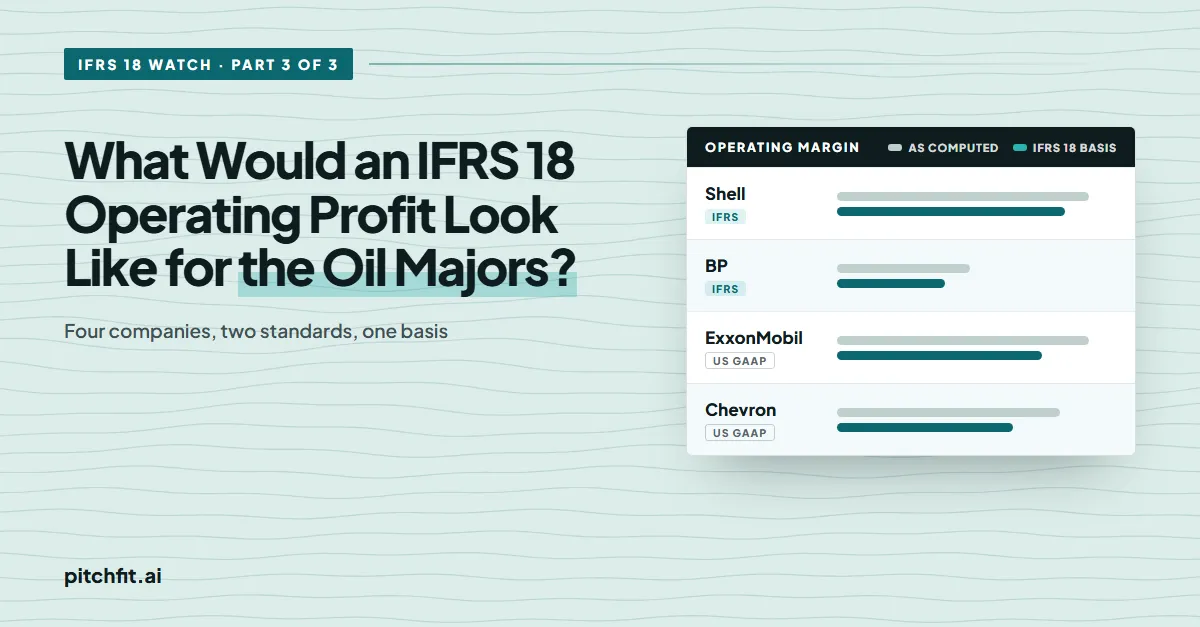
Shell and BP will present an IFRS 18 operating profit from 2027; ExxonMobil and Chevron will publish none. All four on one IFRS 18 basis, 2025 figures.
IFRS 18 Watch, Part 3
Shell's income statement does not present an operating profit, and neither do ExxonMobil's or Chevron's; BP presents a "profit before interest and taxation", but that is a subtotal of BP's own design: today no accounting standard defines it, and it includes items (such as earnings from joint ventures) that IFRS 18 will place outside operating profit. The EBIT margins shown for the four companies today are therefore computed by the data provider or analyst who builds the table. From 2027, Shell and BP will present an operating profit defined by IFRS 18. On our reading of the 2025 disclosures, Shell's would be around 3 billion dollars lower than the EBIT commonly computed for it. ExxonMobil and Chevron, reporting under US GAAP, will publish nothing new: the standard does not reach them, so their published statements keep carrying no operating profit at all. A peer table built on the published figures would then carry two different kinds of number in one column. Comparability comes only from applying the IFRS 18 basis to all four companies, which is what this article does in Section 4, and what a standardised template does for every statement.
Summary
Key point: IFRS 18 gives IFRS reporters a defined operating profit; US GAAP reporters will continue to publish none, so their EBIT stays a computed figure. A mixed peer set becomes comparable only when the same IFRS 18 basis is applied to every member, US GAAP filers included.
Three reclassifications account for the difference: the share of profit of joint ventures and associates moves to the investing category; interest and dividend income moves to investing; and foreign-exchange differences on financing move to financing. On 2025 figures, Shell's margin would move from 12.9% to 11.7% and BP's from 6.8% to 5.5%. ExxonMobil's and Chevron's published figures would not move, but the same reclassifications applied from their notes take them to 10.5% and 9.0%. Only the IFRS 18 basis applied to all four (including the two US GAAP filers, from their notes) compares like with like, and no company publishes that for a mixed peer set.
Terms in this article
- EBIT proxy
- income before tax plus interest expense, the formula most data providers apply when no operating profit is presented.
- Operating profit (IFRS 18)
- the mandatory subtotal comprising all income and expenses not classified in the investing or financing categories.
- Investing category
- income and expenses from associates and joint ventures, from cash and cash equivalents, and from other assets that generate returns largely independently of the entity's other resources.
- Financing category
- interest expense, interest on net defined-benefit obligations, and foreign-exchange differences on financing.
- Equity-accounted entities
- joint ventures and associates, whose share of profit is presented as a single line.
What do the data providers show today?
Key point: on the standard proxy, Shell and ExxonMobil report the same margin, 12.9%.
| Revenue | Income before tax | Interest expense | EBIT as computed | Margin | |
|---|---|---|---|---|---|
| Shell | 266,886 | 29,756 | 4,671 | 34,427 | 12.9% |
| ExxonMobil | 323,905 | 41,268 | 603 | 41,871 | 12.9% |
| Chevron | 184,432 | 19,743 | 1,217 | 20,960 | 11.4% |
| BP | 189,335 | 7,746 | 5,106 | 12,852 | 6.8% |
These are the figures that appear in comparison tables at present. BP's own "profit before interest and taxation" is close to its proxy figure, but no standard defines that line today; BP sets its content, on a replacement-cost basis and including earnings from joint ventures, so it is not the subtotal IFRS 18 will require.
What would IFRS 18 present for Shell and BP?
Key point: on 2025 figures, Shell's first IFRS 18 operating profit would be around 9% below the computed EBIT, with no change in the underlying business.
Operating profit under the standard excludes three items that the proxy includes: the share of profit of joint ventures and associates, which is classified as investing; interest and dividend income, likewise; and foreign-exchange differences on financing, which are classified as financing. Shell discloses all three in its 2025 results. The figures below are the authors' reading of the standard, not Shell's transition disclosure.
| Shell, FY2025 | USD m |
|---|---|
| EBIT as computed above | 34,427 |
| Add back: foreign-exchange losses on financing activities | 537 |
| Less: share of profit of joint ventures and associates | (1,618) |
| Less: interest income | (1,960) |
| Less: dividend income | (81) |
| IFRS 18 operating profit (authors' estimate) | 31,305 |
| Margin | 11.7% |
Shell's gains of 3.2 billion on the sale of businesses and assets would remain within operating profit to the extent they arise from subsidiaries, property or plant; any gain on the disposal of an interest in a joint venture or associate would be classified as investing with the rest of that line. Restructuring charges, impairments and derivative fair-value movements would also remain within operating profit.
| BP, FY2025 | USD m |
|---|---|
| EBIT as computed above | 12,852 |
| Less: net finance income on pensions, to financing | (210) |
| Less: earnings from joint ventures and associates | (618) |
| Less: interest and other income | (1,609) |
| IFRS 18 operating profit (authors' estimate) | 10,415 |
| Margin | 5.5% |
BP's results release does not separate interest income from other income. Any operating component within the 1,609 would return to operating profit when BP's transition note provides the split, so 10,415 should be read as a lower bound. BP's 987 of gains on sale would remain within operating profit.
What do all four look like on the IFRS 18 basis?
Key point: applying the same three IFRS 18 reclassifications to ExxonMobil and Chevron (taken from their notes where the face of the statement does not show them) puts all four companies on one basis. On that basis Shell leads at 11.7%, ExxonMobil follows at 10.5%, Chevron at 9.0% and BP at 5.5%.
Section 3 derived an IFRS 18 operating profit for Shell and BP. The same three reclassifications apply to a US GAAP filer: nothing in the arithmetic depends on which standard the company reports under, only on whether the three items can be read from its statements. ExxonMobil and Chevron both show income from equity affiliates on the face of the income statement; their non-service pension cost and their interest and dividend income are in the notes.
| ShellIFRS | BPIFRS | ExxonMobilUS GAAP | ChevronUS GAAP | |
|---|---|---|---|---|
| EBIT as computed (Section 2) | 34,427 | 12,852 | 41,871 | 20,960 |
| Add back / (less): financing-related items reclassified to financing | 537 | (210) | 400 | 313 |
| Less: share of profit of equity-accounted entities | (1,618) | (618) | (5,064) | (3,000) |
| Less: interest and dividend income, reclassified to investing | (2,041) | (1,609) | (3,269) | (1,599) |
| IFRS 18 operating profit (authors' estimate) | 31,305 | 10,415 | 33,938 | 16,674 |
| Revenue | 266,886 | 189,335 | 323,905 | 184,432 |
| Margin on the IFRS 18 basis | 11.7% | 5.5% | 10.5% | 9.0% |
Notes to the bridge:
- Shell's financing-related item is the foreign-exchange loss on financing activities; BP's is net finance income on pensions; ExxonMobil's (400) and Chevron's (313) are non-service pension cost, which IFRS 18 classifies as financing and the proxy leaves inside operating profit.
- Shell's interest and dividend income is the 1,960 and 81 shown in Section 3. ExxonMobil and Chevron do not separate interest income from "other income" on the face, so the whole of that line (3,269 and 1,599) is reclassified to investing. That is the conservative reading: any operating component inside "other income" would return to operating profit, so 33,938 and 16,674 are lower bounds, in the same way that BP's 10,415 is.
| Margin, as computed today (Section 2) | Margin, as the company would present it from 2027 | Margin on the IFRS 18 basis, all four (this section) | |
|---|---|---|---|
| Shell | 12.9% | 11.7% | 11.7% |
| ExxonMobil | 12.9% | none published; 12.9% as computed | 10.5% |
| Chevron | 11.4% | none published; 11.4% as computed | 9.0% |
| BP | 6.8% | 5.5% | 5.5% |
For Shell and BP the last two columns coincide: once the company presents the IFRS 18 subtotal, it is already on the common basis. For ExxonMobil and Chevron the last column is the figure no one will publish: the company because the standard does not apply to it, the data provider because the proxy stops at the face of the statement.
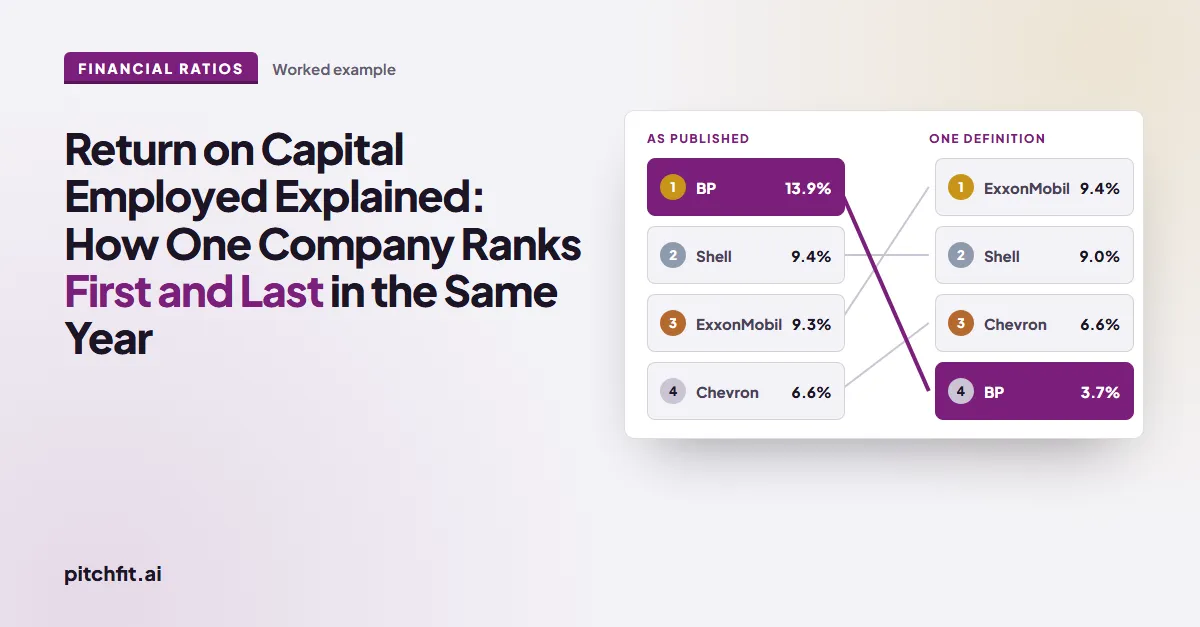
On today's figures Shell and ExxonMobil are level at 12.9%. On the IFRS 18 basis Shell leads by 1.2 points, because a larger share of ExxonMobil's income before tax comes from equity-accounted entities and other income, items the standard moves out of operating profit. Chevron's margin moves from 11.4% to 9.0% for the same reason. None of the four companies has changed anything in its business; only the basis of the comparison has.
What does this mean for a benchmark?
Key point: restated comparatives make each IFRS reporter consistent with its own prior year, not with its peers.
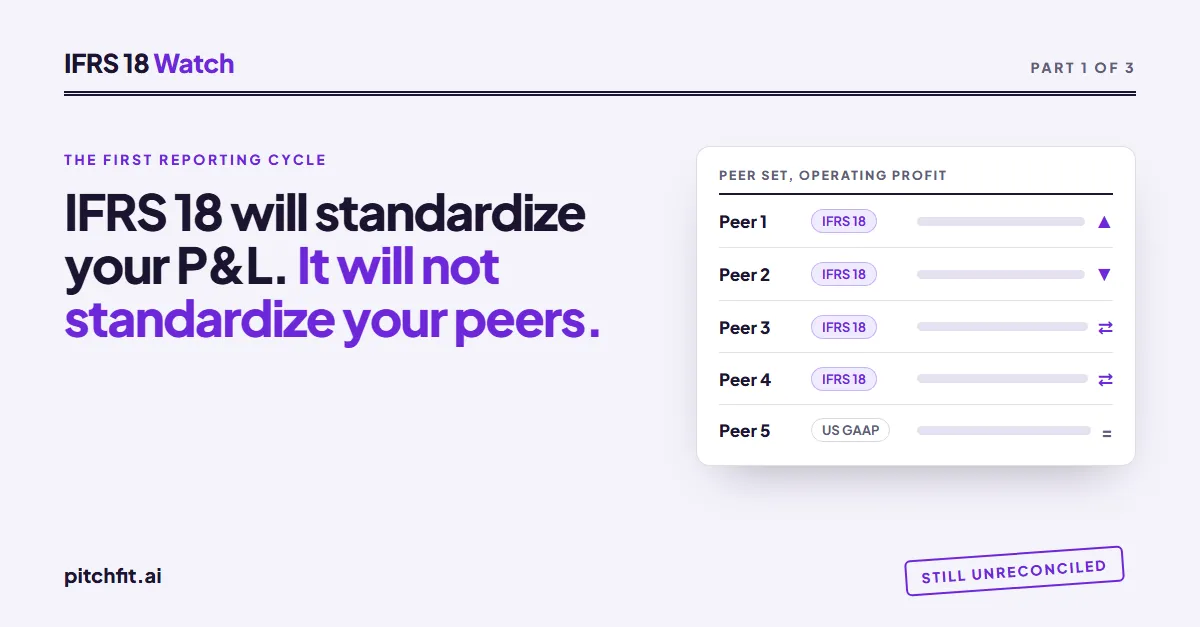
The first IFRS 18 reporting cycle gives IFRS reporters a published operating profit; US GAAP reporters, to whom the standard does not apply, will continue to publish none. A peer set that includes both (which, in energy, automotive, pharmaceuticals, mining and consumer goods, is most peer sets) will carry a defined subtotal for some members and a computed proxy for the others in the same column, unless the reader applies the IFRS 18 basis to all of them, as Section 4 does.
The work of reconciliation therefore remains with the reader. The standard narrows it: it names the categories, moves the equity-accounted line out of operating profit, and brings management-defined measures into the audited notes with their tax effects. It does not perform the final step, which is to place every company on one basis and hold that basis across years, currencies and fiscal calendars. That step is the subject of this series from Part 1: one basis for every statement, applied to US GAAP and IFRS reporters alike, with each figure bridged to the line from which it came.
IFRS 18 should make Shell's and BP's financial statements clearer than they are today. It is likely to make comparison between Shell and ExxonMobil more demanding for readers who take the presented figures as they stand, and more tractable for those who already rebuild them.
This concludes IFRS 18 Watch.
Frequently asked questions
Does IFRS 18 require an operating profit subtotal?
Yes. Operating profit or loss is a required subtotal, comprising all income and expenses not classified as investing or financing, with specific provisions for entities whose main business activities are investing or providing financing.
Why would Shell's operating profit be lower under IFRS 18?
The proxy includes the share of profit of joint ventures and associates and interest income within EBIT; IFRS 18 classifies both in the investing category.
Does IFRS 18 change ExxonMobil's or Chevron's reported figures?
No. The standard applies to IFRS reporters only, so ExxonMobil and Chevron will continue to publish no operating profit. They can still be placed on the IFRS 18 basis by the reader (the same reclassifications applied to their US GAAP figures), which is how Section 4 rebuilds them.
Is BP's profit before interest and taxation the same as IFRS 18 operating profit?
No. No standard defines that line today; BP sets its content, on a replacement-cost basis, and it includes earnings from joint ventures and associates, which IFRS 18 classifies outside operating profit.
Which margin should an analyst use?
Whichever is computed on the same basis for every company in the set. Neither the proxy nor the presented figure achieves that on its own; the IFRS 18 basis applied to all four, as in Section 4, does.
Sources: Shell plc, fourth quarter and full year 2025 unaudited results, consolidated statement of income and the note on interest and other income; bp p.l.c., fourth quarter and full year 2025 results, group income statement; ExxonMobil, 2025 results; Chevron, fourth quarter 2025 results. IFRS 18 classifications are the authors' reading of the standard's requirements. Neither Shell nor BP has yet published a transition note, and the figures the companies present may differ from those estimated here.
Advised on major restructuring and transformation programs at Oliver Wyman before building Rebase to end the "three answers" problem for good.
 Restructuring
 IFRS 18 Watch
 IFRS 18
 IFRS 18 Watch
 Financial ratiosRestructuringIFRS 18 WatchIFRS 18IFRS 18 WatchFinancial ratios